
Free Consultation
Ready to Sell Your Estate or Collection?
Lion & Unicorn's expert team offers free appraisals and nationwide pickup service.
Over 30 years of experience — Florida's most trusted auction house.
How much is my signed sports memorabilia worth? There is no honest number until someone matches the signer, the object, its condition, and the proof that travels with it. A famous name on a ball, photo, jersey, or card can matter. The ink by itself does not set a price.
Start with what you can see. Write down who you believe signed it, what the object is, and which papers came with it. Leave cleaning, repairs, and price guesses for later. A specialist can then tell you whether a review is useful or whether the piece should stay in the family.
Families often want one number because an estate, a move, or a downsizing deadline is close. A single number before the facts are checked is how good pieces get undersold and ordinary pieces get oversold. The first job is to decide which pile the item belongs in. If the piece is already part of a larger collection, the selling path for antiques and collectibles can wait until this sort is done.
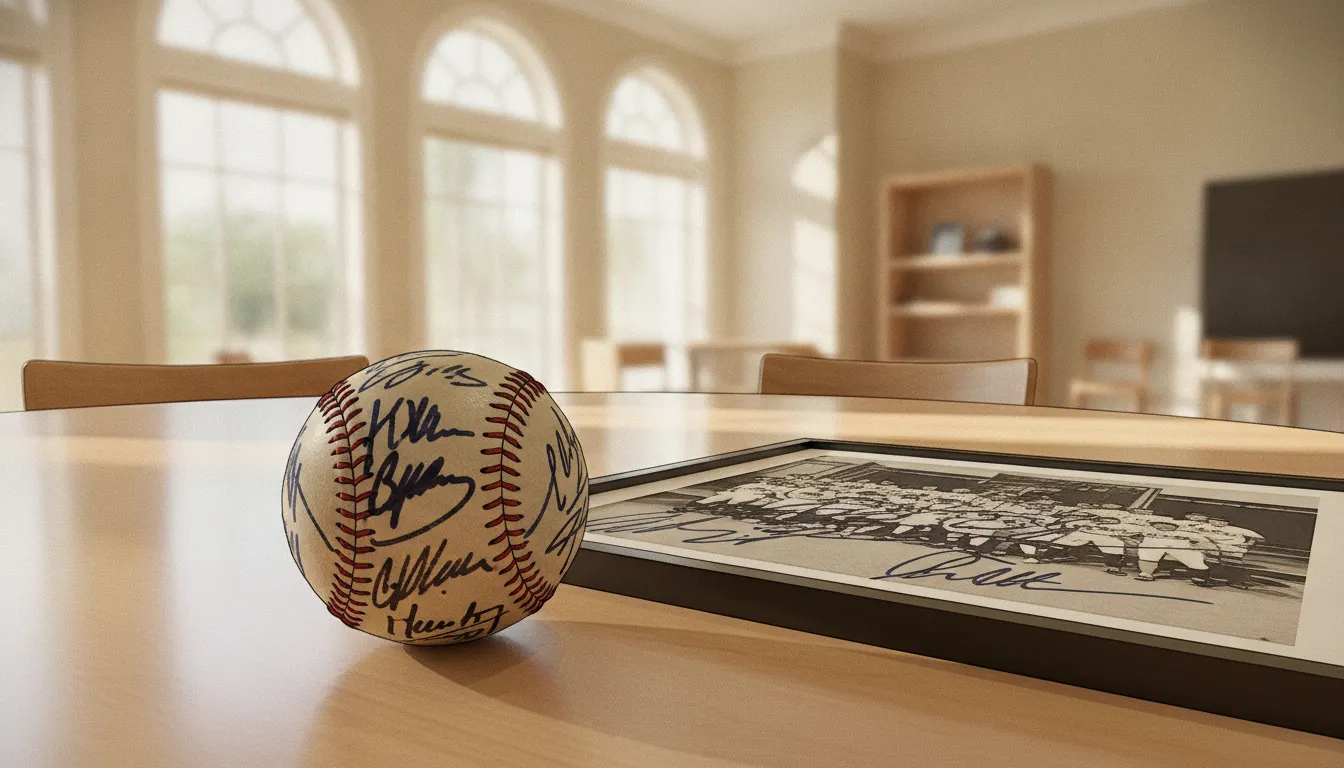
Ask for an appraisal of signed sports memorabilia
How Much Is My Signed Sports Memorabilia Worth Before a Price Guess?
The useful first answer is a range of attention, not a dollar figure. Some pieces deserve a careful look. Others are keepsakes whose market is thin. You can sort them before you spend time or money.
Four facts do most of the sorting:
- Who signed it. A household name, a short career, or a player who rarely signed can change demand. A clubhouse attendant’s signature usually does not.
- What was signed. A game ball, a photo, a jersey, a card, and a cut signature are different objects. Collectors do not price them as if they were the same.
- How it looks now. Faded ink, a cracked photo, a stained jersey, or a scuffed card can matter as much as the name.
- What proof you have. A matching certificate, a receipt, a signing photo, or a numbered hologram is evidence. A story with no paper is not the same thing.
If two or more of those facts are strong, a professional review is reasonable. If the signer is unknown and the object is a mass-produced photo with no papers, the likely result is a keepsake. That is still a fair outcome. It saves you from treating a memory as inventory.
Do not use an online asking price as your number. Listings show what a seller hopes to get. A completed sale, with the same type of item and comparable proof, is closer to evidence. Even then, one result is not a promise for your piece.
Compare like with like. A signed photo is not a stand-in for a signed ball. A modern reprint is not a stand-in for an older print. A certificate from one company is not a stand-in for a certificate from another. When the comparison item differs, the price next to it does not transfer.
Insurance value and a likely selling result are different questions. An insurance figure can reflect replacement cost. A sale depends on who is buying, how the item is offered, and how much proof a buyer will accept. Ask which question you need answered before you treat any opinion as the worth.
What Changes the Worth of a Signed Ball, Photo, Jersey, or Card?
Once the piece clears that first sort, the details decide whether it is ordinary or special. None of these details is a price list. They are the notes a reviewer will ask for.
The signer and the moment
A single star usually draws more interest than a long list of lesser names. A signature tied to a clear moment, such as a retirement season or a championship team, can be easier to explain than a random signing. If you know the year or the event, write it down. If you only have a family story, label it as a story.
The object itself
Balls, photos, jerseys, and cards do not share one market. A ball with a clean single signature is simple to describe. A team photo may carry several names, but glare, fading, or a damaged mat can limit it. A jersey needs size, maker, and any game-use claim kept separate from the signature. A card may need its year, set, and player named exactly, because a close lookalike can be a different issue.
A helmet, a program, a ticket, or a cut signature from a letter is another category. Record the material, the size, and whether the ink sits on the original surface. A signature added to a later reprint should be labeled that way. Hiding that fact does not raise the worth. It creates a problem when a reviewer compares the print with known originals.
Ink, placement, and completeness
A full signature in a clear spot is easier to review than a clipped name in a corner. Personalization, such as a note to a specific person, can narrow the buyer pool even when the signature is real. Missing ink, a smear, or a signature that runs into a fold should be described, not hidden.
One piece or a group
A single strong item can stand alone. A box of mixed balls and photos is often reviewed as a group first. Do not assume the best piece sets the value of everything around it. Separate the pieces you can identify from the ones you cannot.
Keep a short note for each type of piece. The note is a record, not a price.
- Single signed ball. Write the player, ink color, panel, case, and any sticker number. A name that matches the sticker is easier to review.
- Signed photo. Write the size, color or black-and-white, any dedication, and mat damage. A clear image helps. A dedication can narrow demand.
- Signed jersey or shirt. Write the size, maker, stains, and any claim that it was worn. Keep the signature and a game-use claim as two facts.
- Signed card. Write the year, set name, player, corners, and any grade label. The issue and the condition can matter as much as the ink.
- Mixed box. Write the count, the best pieces, and which papers match one item. Review the strongest pieces before the rest of the box.
| Question | Stronger position | Weaker position |
|---|---|---|
| Signer | The name is readable. | The name is a guess. |
| Object | The item type is known. | The item is unclear. |
| Condition | The ink is intact. | The ink is faded. |
| Proof | Papers match this piece. | Papers match something else. |
| Next step | Ask for a review. | Keep it as a memory. |
Which Proof Helps, and Which Proof Does Not?
Proof is the part most families overrate. A certificate that names a different item, or a hologram you cannot check, does not become stronger because it looks official. Match every paper to the object in front of you.
Helpful proof usually includes:
- A certificate or letter that describes this object, not a generic stack of photos.
- A certification number you can check with the company that issued it.
- A receipt, invoice, or dated note from the person who obtained the signature.
- A photo of the signing that shows this object, not a similar one.
- An original sticker, tamper seal, or holder that is still intact.
A certification number is useful only when you can match it to the object in your hand. The number on a holder or sticker should describe this ball, photo, jersey, or card. A letter that could belong to any item is weak proof. A lookup is a record to check. It is not a sale price, and it is not a promise that an older letter from a different company will pass the same test.
Forged signatures are a known fraud problem, not a rare rumor. The U.S. Department of Justice has charged sellers who offered memorabilia with phony autographs of sports stars and celebrities. That case is a charge, not a verdict, but it shows why a seller should not call a piece authenticated unless the paperwork matches and can be checked.
If your papers are missing, say so. A real signature can exist without them, but the reviewer has less to work with. If the papers name another player or another object, do not attach them to the wrong piece. Wrong papers create more doubt than no papers.
A photo of you beside an athlete is pleasant context. It does not prove that the ball in a closet is the ball from that day. Write the date and place if you know them. Then let the reviewer decide what the photo supports.
Treat stickers and holders as part of the record. Do not peel a hologram to see what is under it. Do not move a ball into a new case before the review. The holder can help explain the piece. Breaking it to make the piece look tidier can make the record harder to trust.
For the deeper question of how a signature is reviewed before a sale, read how authentication and provenance affect sports autographs. This guide stays on the earlier question: is the piece worth that review at all?
When Is Signed Memorabilia Ready for a Specialist Review?
A review is worth requesting when the signer is identifiable and at least one other fact is strong. That second fact might be a desirable object, clean condition, matching paperwork, or a group of related pieces from the same source.
Bring the object, the papers, and a short note. The note should cover where you got it, what you know, and what you are guessing. Keep those three lines separate. A reviewer can use a fact. A guess presented as a fact wastes the visit.
- Identify the signer and the object in one sentence.
- List papers, numbers, and stickers that belong to this piece.
- Describe damage in plain words, including fading, stains, creases, and missing parts.
- Say whether you want a value opinion, a selling route, or both.
- Leave the piece in its case or sleeve unless a specialist asks you to open it.
You can stop before a review when the signer cannot be identified, the object is a modern mass print, and nothing ties it to a signing. You can also pause when the item is damaged so badly that the signature is gone. In those cases, a family keepsake may be the right result.
A review is also reasonable when several relatives need the same answer. One shared opinion is clearer than three people each trusting a different online listing. Bring the items and the papers together so a strong piece is not separated from the note that explains it.
Ask what the opinion is for. A decision to insure, a decision to keep, and a decision to sell can point to different next steps. You do not need to choose a selling route on the same day. You do need to know whether the piece merits more work.
Football gear has its own details, especially jerseys and game-use claims. If that is the whole collection, use the football memorabilia seller guide after you finish this first sort. Do not force a mixed box of balls and photos into a football-only answer.
Lion and Unicorn reviews sports items alongside art, antiques, and other collectibles. The conversation can start with one piece or with a box from an estate. Photos help, but the object and its papers matter more than a cropped picture of the ink.
Send photos of a signed piece for a specialist look
Frequently Asked Questions
Does a signature by itself tell me the value?
No. The signer matters, but so do the object, the condition, and the proof. Two signatures by the same player can deserve very different attention.
Should I clean a signed ball or photo before a review?
No. Cleaning, tracing, or pressing a signature can remove the evidence a reviewer needs. Leave the piece as it is and describe any dirt or damage instead.
Is an old certificate enough?
Only if it describes this object and you can match its number or hologram to the issuer. A loose letter that could belong to any item is weak proof.
What if I inherited a box and know none of the names?
Sort out the pieces with readable names and matching papers. The rest can wait. A mixed estate box is often reviewed as a group, not priced item by item on the first pass.
Where do I sell after I know it is worth a closer look?
That is a later decision. A direct buyer, a marketplace, or an auction can fit different pieces. If you want the selling steps, start with how to sell sports memorabilia, then compare who buys sports memorabilia and how auction consignment works. Buyers at Lion and Unicorn auctions pay a 30 percent buyer’s premium on the hammer price. Taxes and any other charges follow the current auction terms, so ask for those before you decide.
When the signer, the object, and the papers point the same way, ask for a review instead of hunting for a single number online. Bring what you have, label what you only remember, and let the specialist tell you whether the next step is a sale or a keepsake.
Call Lion and Unicorn at (954) 866-8044 to talk through a signed ball, photo, jersey, or card.
Free Consultation
Ready to Sell Your Estate or Collection?
Lion & Unicorn's expert team offers free appraisals and nationwide pickup service.
Over 30 years of experience — Florida's most trusted auction house.