


Is My Old Wedgwood Worth Anything?
Free Consultation
Ready to Sell Your Estate or Collection?
Lion & Unicorn's expert team offers free appraisals and nationwide pickup service.
Over 30 years of experience — Florida's most trusted auction house.
That inherited Wedgwood cabinet may hold more than one kind of piece. Some appeal to collectors. Others matter mainly as part of a family group. Age alone does not set a price. A glance at the shelf rarely tells the story.
Is my old Wedgwood worth anything? It may be, but the answer depends on the individual object and the market for it. A specialist will usually consider the maker’s mark, pattern, condition, provenance, and whether related pieces form a coherent collection before suggesting a selling route or valuation.
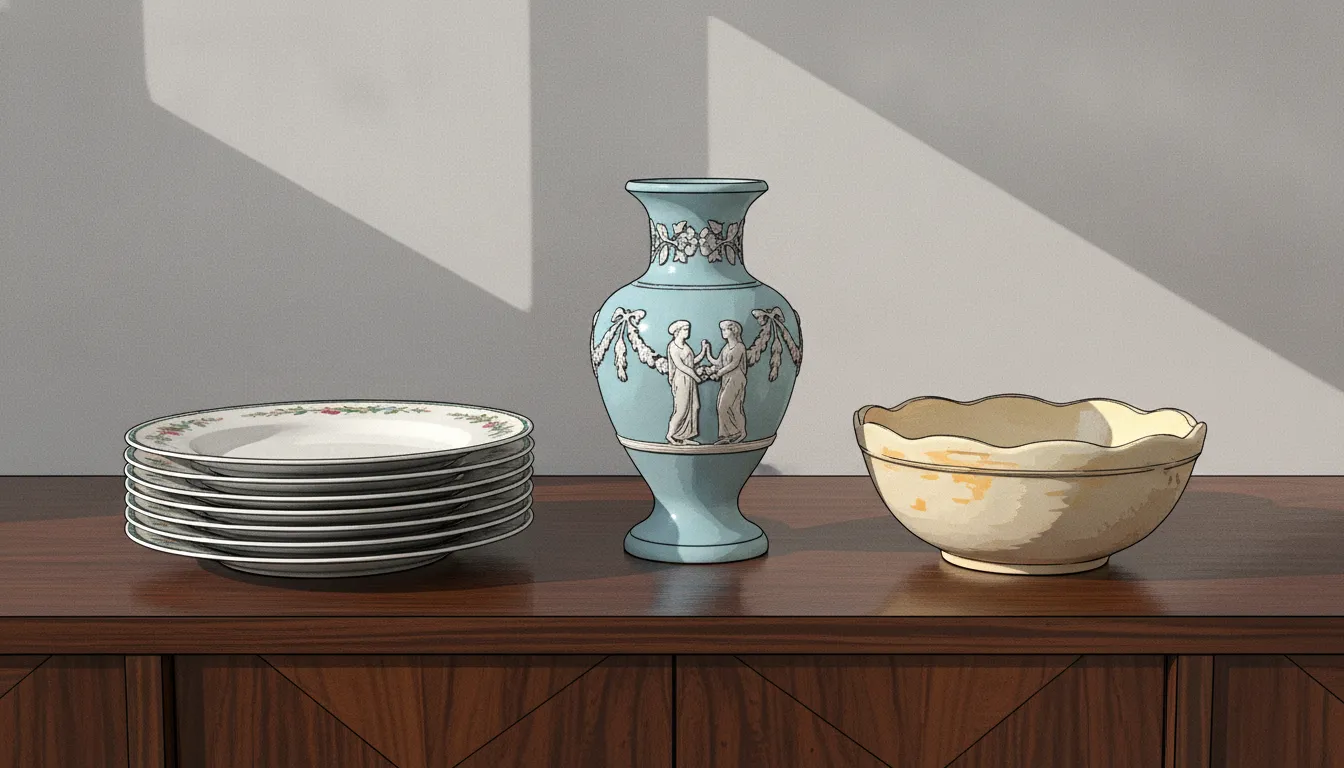
Request a specialist look at your Wedgwood before you sell pieces one by one.
Before you keep, give away, or sell, name what each piece is made from. Then see how the group fits together. Unlike objects should not be judged by one standard.
Separate the bodies before you judge the cabinet
Old Wedgwood is not one product. The name on the base is only the start. A mixed cabinet can hold several bodies, and each body has its own buyers.
Group pieces by what they are made from, and by how they were used. Jasperware is the familiar one: a colored body, often blue, with white relief. Bone china and Queens Ware are usually tableware, such as plates, cups, and dinner services. Black basalt is a dark, matte, stone-like body. Lustre and other cabinet pieces are judged on finish, form, and decoration, not on a blue-and-white look.
This sort stops a common mistake. People price every piece as if it were a jasperware souvenir. Value follows the body, the exact object, its age, its condition, and current demand. The brand name alone does not.
Pale blue jasperware made in huge numbers late in the 20th century is usually the common end of that market. It can still be attractive. A dinner service is a different market from one decorative vase, and a missing lid changes the set. If you already know the piece is jasperware, use the guide to jasperware pattern and age. Do not apply that guide to the rest of the cabinet.
- Jasperware: A colored body, commonly blue, with white applied relief decoration. Sort these separately from tableware and inspect each form on its own.
- Bone china or Queens Ware tableware: Plates, cups, serving pieces, and dinner services. A complete or incomplete service raises different questions from a single decorative object.
- Black basalt: A dark, usually matte body with a stone-like appearance. Its form, finish, condition, and period still need to be identified.
- Lustre or decorated cabinet pieces: Display objects whose painted, lustred, or otherwise elaborate decoration may be central to their appeal. Record the shape and condition before making comparisons.
Read the mark only far enough to sort the piece
A Wedgwood mark can place a piece in a broad period. It is not a price. Read every letter.
A mark ending in & Co is Wedgwood & Co, not Josiah Wedgwood. A middle E in WEDGEWOOD, or the wording W S & Co, points to William Smith & Co. Similar names can mean different makers.
Be cautious with the phrase “Old Wedgwood.” Among collectors, it generally refers to wares made before Josiah Wedgwood’s death in 1795. Pieces in that group can be especially difficult to date from a photograph alone. A mark may be an important clue, but the shape, decoration, materials, condition, and any available history still need to be considered.
For later pieces, a coded mark can narrow the search without settling it. From 1860, the factory used an impressed three-letter code. The third letter relates to the year, but the code was repeated, so one code can correspond to more than one year. Do not treat a single code as a unique date, and do not rely on a month-letter chart as though it were a final answer.
There are also broad changes in the wording of the mark. After 1891, ENGLAND was added to the WEDGWOOD mark. From about 1908, MADE IN ENGLAND generally replaced it. Small items can be exceptions, and marks were reused, so these phrases establish a useful range rather than an exact production date. For the reference details, see the Wedgwood mark dating notes.
Use the result as a sorting note: earlier, later, or still uncertain. That can help determine what additional research or specialist review is worthwhile. It does not set a price. The source itself warns that manufacturers interchanged marks and recommends verification when the information is being used for a sale. If the mark is faint, incomplete, or inconsistent with the object, preserve clear photographs of the mark and the full piece rather than forcing it into a date range.
How do I decide if my old Wedgwood is worth anything?
A mixed cabinet rarely has one simple answer. Start by separating pieces that show a potentially useful maker or pattern signal from items that are common, damaged, or made by a different company. This first pass helps you decide what to photograph, keep together, or show to a specialist without treating every old-looking piece as equally important.
Quick triage for an older Wedgwood collection
| What you have | First read | Next step |
|---|---|---|
| Impressed WEDGWOOD only, with no country name. Crisp relief or a Wedgwood and Bentley mark. | An early band of production may deserve closer attention. | Keep it separate and request a specialist review rather than grouping it with ordinary tableware. |
| A pale blue jasperware pin tray, lighter, or small vase marked MADE IN ENGLAND | This is common later production. It may be enjoyable, but one small piece is unlikely to carry a cabinet on its own. | Keep it if you like it, and compare the color and mark details in our guide to jasperware colors and marks. That page covers those details, so they are not repeated here. |
| A complete bone china dinner service in one pattern. Lids and serving pieces are present. | Individual plates may be ordinary, while a complete, well-matched set can still merit review. | Keep every component together and read our guidance on selling inherited china and dinnerware before separating or disposing of pieces. |
| Chips, hairlines, staining, missing lids, or flattened relief | Condition can matter more than age. Damage may change how a buyer views an otherwise promising object. | Record flaws clearly and include close photographs before asking for an assessment. |
| Lustre fairy scenes, black basalt, or an unfamiliar decorated vase | The form or decoration may be less straightforward to identify from a quick cabinet inspection. | Set it aside for a specialist. Do not guess at a category or value from a name that only sounds familiar. |
| A mark reading Wedgwood & Co or WEDGEWOOD | This indicates a different maker and should not automatically be treated as Josiah Wedgwood. | Photograph the full mark and the object, then seek identification before using it in a valuation. |
The safest approach is to preserve context: keep matching pieces, lids, and serving items together, and do not polish or repair them before they are reviewed. A specialist can weigh the mark, form, completeness, condition, and the collection as a whole. That is more useful than relying on age alone or assuming that a familiar name guarantees a meaningful result.
Photograph the piece before you ask what it is worth
A clear photo set gives a specialist useful evidence before an item is handled or inspected in person. It also helps you separate a question about identification from a question about market value. Use natural light where possible, keep the camera parallel to the object, and avoid filters that alter colour or hide surface details.
- Photograph the full piece. Place it on a plain, uncluttered background and include the entire object in the frame. Take more than one angle if its shape, handles, feet, lid, or other details are difficult to see from the front. For a cabinet or group, photograph the arrangement as a whole as well as the individual pieces.
- Show the entire base mark. Turn the piece over safely and photograph the full underside, including the maker’s mark, printed wording, labels, and any handwritten marks. Use a light coming from the side rather than directly above. Raking light can reveal impressed marks that are easy to miss in an ordinary photograph.
- Capture pattern and shape information. If you can see a pattern name, design number, shape number, date code, or other identifying mark, take a close, legible image. Do not guess at letters or numbers in your notes; an uncertain mark is more useful when it is clearly labelled as uncertain.
- Photograph relief and painted decoration. Take close views of raised ornament, applied figures, moulded borders, gilding, hand-painted details, and areas where the decoration changes. These details may not be visible in a full-piece photograph.
- Document condition honestly. Include close images of every chip, crack, stain, scratch, missing element, restoration, or repair you notice. Photograph the surrounding area as well as the damage so its location and extent are clear.
- Add something for scale. Include a ruler or another familiar measuring reference beside the object, without covering any mark or decoration. Give dimensions in your message as well, including height, width, and diameter where relevant.
- Include original paperwork or packaging only when it belongs to that piece. A box, certificate, receipt, or provenance document can be useful when it is genuinely associated with the object. Do not combine unrelated paperwork with the photo set.
Online asking prices are not sold prices, and a photo set is not an appraisal. It is preliminary information for deciding whether a specialist review makes sense. Lion & Unicorn reviews porcelain and ceramics for auction, including single pieces and whole cabinets, from its Hollywood, Florida gallery with nationwide pickup. You can learn more about antique appraisals before sending your images.
Is my old Wedgwood worth anything as a group?
One plate rarely answers the question. A cabinet does. Heirs often inherit a mix: a blue vase on the top shelf, a partial dinner service in the sideboard, and a dark bowl nobody can name. Judging that mix one souvenir at a time throws away the only thing a specialist can use, which is the pattern across the group.
Keep matching pieces together. A lid belongs with its pot. Serving pieces belong with the plates that share their pattern. A single chipped plate from a service of twelve tells a different story than twelve odd plates from twelve patterns. Write a short list before you move anything: body type, mark wording, pattern name if you can read one, and the flaws you can already see.
Then split the list into three piles.
- Show first. Impressed WEDGWOOD with no country name, a Wedgwood and Bentley mark, crisp relief, black basalt, lustre, or a complete service in one pattern.
- Keep if you like it. Later pale blue jasperware and ordinary single plates. They can stay in the family without a sale.
- Identify before you assume. Marks that say Wedgwood & Co or WEDGEWOOD. Those names are not Josiah Wedgwood, even when the look is close.
Lion & Unicorn looks at porcelain and ceramics this way, from single pieces to whole cabinets, at its Hollywood, Florida gallery, with pickup arranged nationwide. The review is a look at what you have. It is not a promised price. If the cabinet also holds crystal or glass, the same sort-first habit is covered in our note on how to sell crystal glassware.
A useful ask is specific. Send the list, the base photos, and a shot of the cabinet as it sits. Say which pieces you would rather keep. That is enough for someone to tell you whether the group deserves a closer look. Or whether most of it is ordinary tableware you can decide about at home.
Ask for a specialist review of your Wedgwood
Frequently asked questions
Is all old Wedgwood valuable?
No. The name covers jasperware, bone china, Queens Ware, black basalt, and later decorated pieces. Some of that is collected. A lot of later tableware and small pale blue jasperware is ordinary. The body, the mark, the form, and the condition decide which is which.
Can the mark tell me what my Wedgwood is worth?
It can sort the piece into a broad period. It cannot set a price. ENGLAND and MADE IN ENGLAND are later wording. A three-letter code can fit more than one year. A mark with & Co, or the spelling WEDGEWOOD, may be a different maker entirely. Confirm a faint mark before you rely on it.
Is a full dinner service worth more than one plate?
Often, yes, if the pieces match. A single everyday plate is usually modest. A service that still has its lids and serving pieces is a different offer, so keep the set together until someone has looked at it as a group.
Do chips make Wedgwood worthless?
Not always, but damage often matters more than age. A chip, a hairline, a stain, a missing lid, or flattened relief changes what a buyer will consider. Photograph the flaw. Do not repair it before a review.
When should I ask a specialist?
Ask when the mark has no country name, when you see Wedgwood and Bentley, when the cabinet mixes several bodies, or when you cannot tell jasperware from china. A clear photo of the base is enough to start. You do not need a price guess first.
Ask for a look before you split the cabinet
If the mark is hard to read, or the cabinet mixes jasperware with china, send photos before you sell pieces one by one. A specialist can separate early marks from later tableware.
Send photos of your Wedgwood for a specialist review or call 954-866-8044.
Free Consultation
Ready to Sell Your Estate or Collection?
Lion & Unicorn's expert team offers free appraisals and nationwide pickup service.
Over 30 years of experience — Florida's most trusted auction house.