


Capodimonte Porcelain Value Guide: How to Identify and Sell Your Collection
Free Consultation
Ready to Sell Your Estate or Collection?
Lion & Unicorn's expert team offers free appraisals and nationwide pickup service.
Over 30 years of experience — Florida's most trusted auction house.
How much is Capodimonte porcelain worth? It depends on whether the piece is an early Royal Factory example, a later Naples or Italian studio work, or a modern item sold in the Capodimonte style. The mark matters, but so do the porcelain body, modeling, condition, maker, size, subject, and provenance. A familiar crowned N is a starting point for research, not proof of age or value.
Request a free Capodimonte valuation so an experienced specialist can review the mark, condition, and selling options before you commit to a price.
What Is Capodimonte Porcelain?
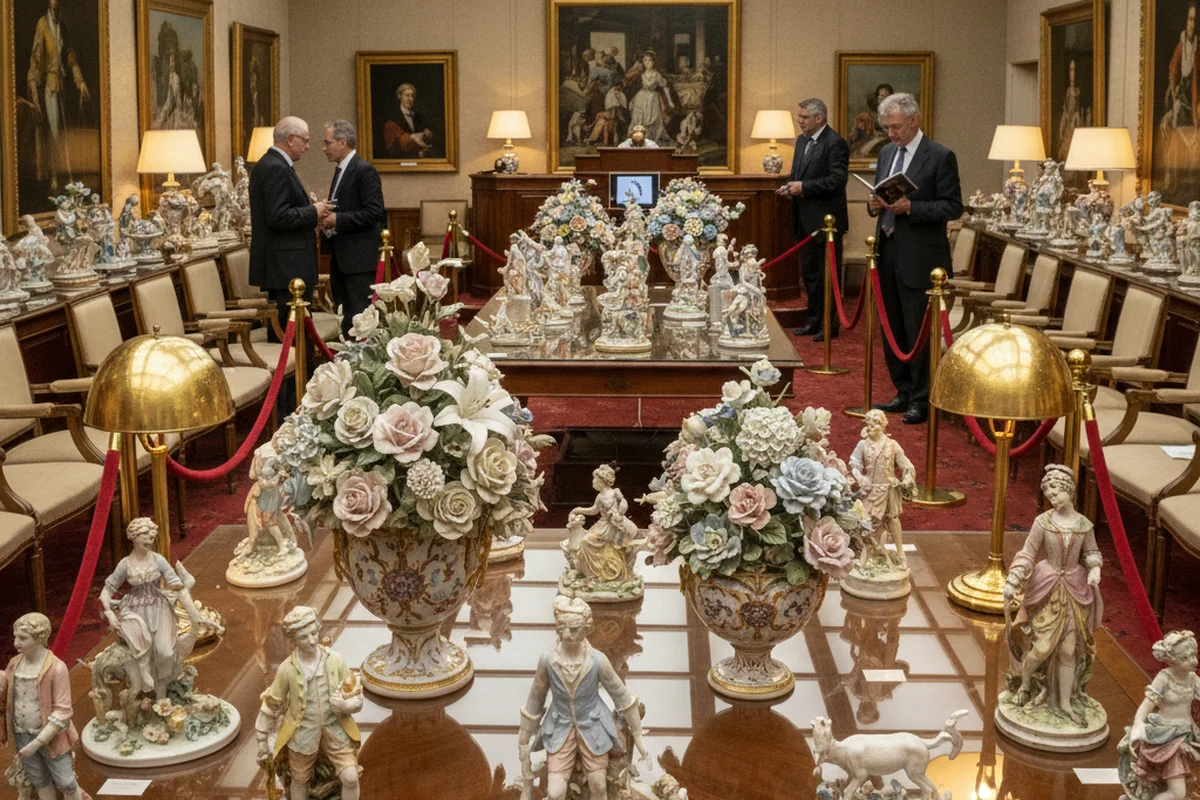
Capodimonte is a name associated with Italian porcelain, especially the Royal Factory established in Naples in 1743 by King Charles of Naples and Queen Maria Amalia of Saxony. The original factory produced soft-paste porcelain and became known for finely modeled figures, floral groups, tableware, and decorative objects. Museum collections identify original examples from 1743 to 1759 as soft-paste porcelain made in Naples.
When Charles became King of Spain in 1759, production and many skilled workers moved to the Buen Retiro factory near Madrid. Later Naples production and many Italian makers continued related styles. As a result, the word Capodimonte may describe an original Royal Factory piece, a later Naples work, a named Italian manufacturer, or a modern decorative piece that borrows the look.
That history explains why two pieces with similar floral decoration can have very different values. A mark, shape, and style must be assessed together. For more context on related European porcelain, see our Royal Bayreuth porcelain value guide.
How Much Is Capodimonte Porcelain Worth?
There is no single Capodimonte price. Common modern pieces usually occupy a modest market, while attractive later figurines and floral groups can appeal to collectors. Better documented Italian studio or revival pieces occupy a stronger tier, and rare, important early works can command exceptional prices when authenticated and offered to the right audience.
The ranges below are orientation only, not an appraisal or a promise of a sale price. Auction estimates change with the maker, exact model, condition, completeness, buyer demand, and whether the piece is correctly identified.
| General category | Typical market orientation | What can move the value |
|---|---|---|
| Mass-produced modern decorative pieces | Modest market tier | Completeness, decoration, size, and whether the item has a recognized maker |
| Common later figurines, vases, or floral pieces | Broad collector market | Condition, quality of hand finishing, scale, and demand for the subject |
| Better Italian studio or revival work | Stronger collector tier | Maker, rarity, modeling quality, provenance, and recent sold comparables |
| Early Royal Factory or exceptional documented works | Top specialist tier | Authenticity, period, rarity, condition, provenance, and specialist competition |
Do not use an asking price as proof of value. Compare completed sales for the same maker, model, size, and condition. An unsold listing shows what a seller hopes to receive; a completed auction or private sale provides stronger market evidence.
How to Identify Capodimonte Porcelain
Identify Capodimonte porcelain by combining the base mark with the body, modeling, decoration, construction, condition, and provenance. Start with photographs and measurements, then compare the exact form and mark with reliable museum records and completed sales. This process helps you sort a collection without treating a familiar symbol as proof of age.
1. Photograph the base mark
Turn the piece over carefully and photograph the entire base, mark, label, and any numbers. Record whether the mark is painted, impressed, incised, printed, or on a sticker. Note the ink color and whether the mark appears under or over the glaze. A close photograph is useful, but a mark by itself cannot establish age.
2. Examine the porcelain body
Look for a fine, smooth body and the translucency associated with soft-paste porcelain, while remembering that lighting and glaze can change its appearance. Avoid making an authenticity decision from color alone. Inspect the foot rim, underside, and unpainted areas for firing flaws, repairs, glaze wear, or a different material.
3. Inspect the modeling and decoration
Capodimonte is known for detailed figures, flowers, and decorative scenes. Look closely at facial features, hands, petals, leaves, lace, scrollwork, and painted details. Hand finishing can show small variations, but variation is not automatically proof of age. Also look for mold seams, glued elements, repeated details, and hurried paintwork that may point to later mass production.
4. Check the construction and completeness
Measure the height, width, and depth. Check whether figures, fingers, petals, leaves, handles, finials, lids, and other small elements are present. Use a flashlight to look for hairline cracks and old repairs. Do not flex fragile parts or test a piece by tapping it. A professional can assess stability without adding damage.
5. Research the maker and model
Look for a maker name, artist signature, model number, catalog reference, or original paperwork. Later Italian makers may produce excellent work, but a later piece should not be described as an original 18th-century Royal Factory object. Search by the exact mark and form, then compare museum records and completed sales rather than relying on a generic Capodimonte label. If your collection includes other European ceramics, our Royal Doulton value guide and Lladro identification guide show how maker and model details can affect research.
6. Gather provenance
Save receipts, old photographs, estate inventories, exhibition records, and family notes. Provenance does not replace physical examination, but credible ownership history can help establish where a piece has been and how it should be researched. Be careful with stories that cannot be documented, especially claims of royal ownership.
Capodimonte Marks: Fleur-de-Lis, Crowned N, and Later Marks
Capodimonte marks can help narrow an object’s period and origin, but no single fleur-de-lis or crowned N proves authenticity. Compare the mark’s application and design with the porcelain body, decoration, construction, and history. Later makers reused familiar symbols, so mark identification should lead to further research rather than end it.
The early fleur-de-lis
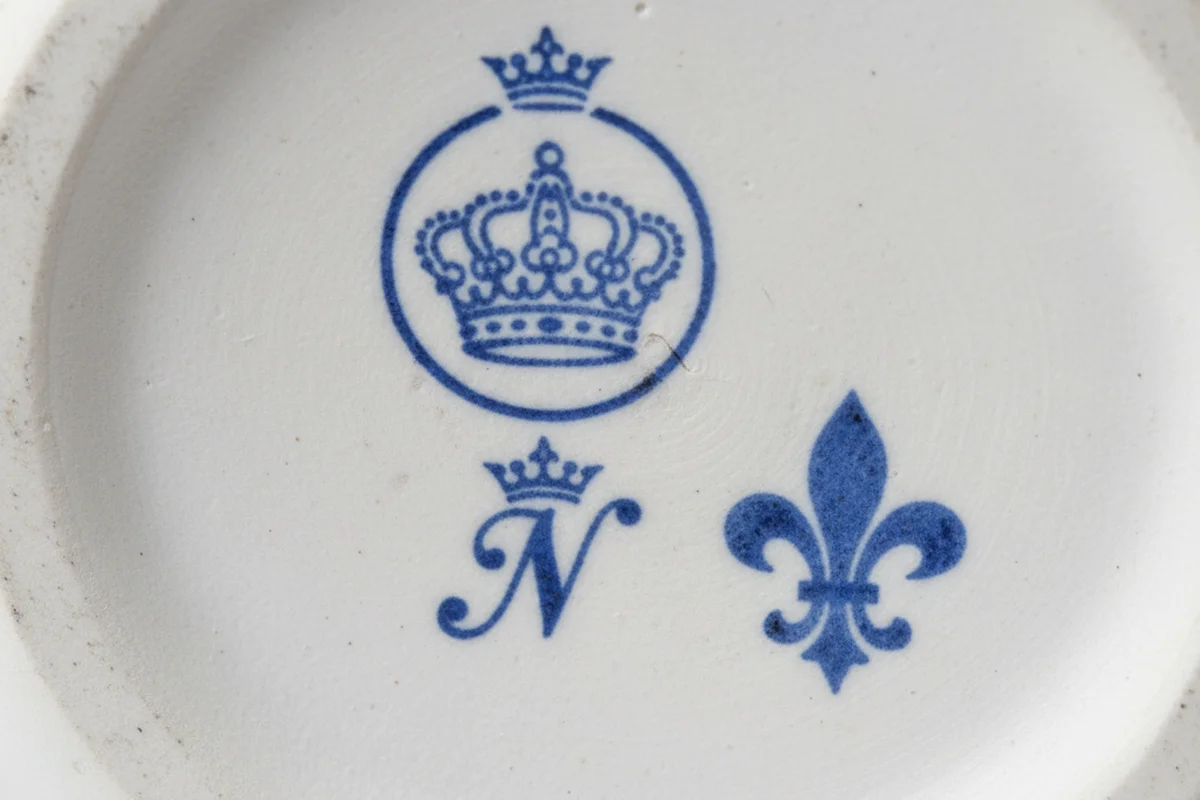
Original Capodimonte factory pieces are associated with a fleur-de-lis mark, often painted in underglaze blue, with variations and later copies also encountered. Museum examples from the 1743-1759 period show how this mark can appear on soft-paste porcelain. A genuine early piece may be important, but the mark must match the body, decoration, construction, and documented history.
The crowned N
A crowned N is commonly associated with later Naples production and is also found on many later Italian pieces. Because the design has been reused, a crowned N alone does not prove that a piece was made at the original 18th-century factory. Compare the form of the crown and letter, the way the mark was applied, the porcelain, and the overall style.
Warning signs and common mistakes
- Treating every crowned N as an 18th-century Royal Factory mark.
- Assuming a sticker is proof of a recognized maker.
- Ignoring a crack, missing flower, replacement part, or heavy restoration.
- Calling a piece antique because it looks elaborate or has a family story.
- Cleaning painted decoration or gilding before an expert sees it.
A country mark that points to France or Germany deserves careful investigation because it does not support a simple claim of Italian Capodimonte manufacture. It may indicate a different porcelain tradition, a reproduction, or later decoration. Keep the wording cautious until the whole object has been reviewed.
What Affects Capodimonte Porcelain Value?
Collectors and auction specialists usually weigh period, authenticity, maker, condition, rarity, size, subject, provenance, and current demand at the same time. The strongest valuation is not based on a mark or an online asking price alone. It explains what is known, what remains uncertain, and which completed sales provide a reasonable comparison.
- Period and authenticity: An authenticated early work is evaluated differently from a later studio or mass-produced item.
- Maker and artist: A documented maker, model, or sought-after artist can make a major difference.
- Condition: Chips, cracks, repaired breaks, missing flowers, restored paint, and replaced parts can reduce value substantially.
- Rarity: Unusual forms, large groups, scarce subjects, and limited production can attract more collector interest.
- Quality: Fine modeling, careful painting, complex composition, and well-preserved gilding support stronger results.
- Size and visual impact: Larger pieces may attract attention, but size alone does not create value.
- Provenance: Credible ownership records can help establish importance and market confidence.
- Market and presentation: The right photographs, description, category, timing, and sales channel affect the result.
Insurance value, replacement value, retail asking price, dealer offer, auction estimate, and final auction result are different numbers. If you plan to sell, ask for a selling-oriented fair market opinion rather than assuming an insurance value is what a buyer will pay.
How to Get Capodimonte Porcelain Appraised
Start with a clear inventory. Photograph the front, back, sides, base, mark, label, and every damaged area. Include a ruler or measuring tape in one image, and list the dimensions, quantity, known maker, purchase history, and any repairs. Keep fragile pieces in a safe location while the review is pending.
A remote review can help determine whether a collection merits an in-person examination and which pieces need priority. A formal written appraisal may require hands-on inspection and a clearly stated purpose, such as insurance, estate settlement, donation, or sale. Tell the appraiser what decision you need to make, because the appropriate valuation method depends on that purpose.
Do not polish, repaint, reglue, remove old labels, or discard packing materials before the review. Repairs can be more visible after cleaning, and an original label or fragment may provide useful evidence.
Where to Sell Capodimonte Porcelain
The best selling route depends on the quality and size of the collection, the time available, and the amount of help needed. A specialist auction house may be the better fit for rare or fragile pieces, while a dealer or marketplace may be simpler for common items. Larger estates may benefit from one coordinated liquidation plan.
Specialist auction house
A specialist auction house can be a strong fit for rare, fragile, or multi-piece collections. The team can research the objects, set expectations, photograph and catalog them, market them to collectors, and coordinate bidding, packing, and shipping. Ask how the estimate was developed, what fees apply, whether the collection will be grouped or sold individually, and how unsold lots are handled.
Antique dealer
A dealer may offer a faster, simpler sale, but the offer usually reflects the dealer’s costs, risk, and need for resale margin. This can make sense for common pieces or sellers who value speed over the possibility of competitive bidding. Get more than one opinion when the collection may contain a rare or unusual work.
Online marketplace
Online marketplaces can work for identifiable, lower-value pieces with strong photographs and realistic pricing. The seller must handle questions, packing, insurance, returns, and shipping damage. A fragile or high-value object may need more specialized handling than a general marketplace provides.
Estate liquidation
If Capodimonte is part of a larger estate, a full-service estate or auction plan may be more efficient than selling each item separately. A specialist can sort the collection, identify pieces that deserve individual cataloging, and coordinate the remaining household contents. See Lion & Unicorn’s guide to selling antiques and collectibles for related planning questions.
Send photos for a free online estimate before listing or accepting an offer, especially when a collection includes multiple pieces, delicate flowers, unusual marks, or inherited provenance.
Frequently Asked Questions
These answers can help you decide what to document next, but an uncertain or potentially valuable piece should be reviewed as a complete object.
Is Capodimonte porcelain valuable?
It can be. Common modern pieces may have modest resale value, while rare, authentic, well-preserved, and documented works can achieve substantially stronger prices. The mark alone is not enough to determine where a piece falls.
Does a crowned N prove that Capodimonte is antique?
No. The crowned N was used by later Naples and Italian makers and has been copied. Examine the application of the mark, porcelain body, decoration, construction, condition, and provenance together.
What is the most valuable Capodimonte porcelain?
Exceptional early Royal Factory works, rare forms, finely modeled groups, and pieces with strong documentation can command the most attention. Value still depends on condition, authenticity, and the audience reached by the sale.
Should I clean Capodimonte porcelain before selling it?
No. Avoid abrasive cleaning, polishing, repainting, and repairs until a specialist has inspected the piece. Cleaning can damage decoration or remove evidence that helps establish age and condition.
What photographs do I need for a Capodimonte valuation?
Provide well-lit images of every side, the base mark, labels, details, damage, and any repairs. Add the dimensions, quantity, known history, and close-ups of unusual details. Keep the original images at full resolution.
Next Steps for Your Capodimonte Collection
Before choosing a price, identify the mark, document the condition, research the maker, and compare the complete object with verified sold examples. If you inherited a collection or are preparing an estate, a specialist review can help separate common decorative pieces from items that deserve individual attention.
Get a free valuation for your Capodimonte porcelain and learn whether an appraisal, consignment, auction, or estate-sale plan is the right next step.
Free Consultation
Ready to Sell Your Estate or Collection?
Lion & Unicorn's expert team offers free appraisals and nationwide pickup service.
Over 30 years of experience — Florida's most trusted auction house.