

Royal Doulton Figurines: Complete Value and Identification Guide
Free Consultation
Ready to Sell Your Estate or Collection?
Lion & Unicorn's expert team offers free appraisals and nationwide pickup service.
Over 30 years of experience — Florida's most trusted auction house.
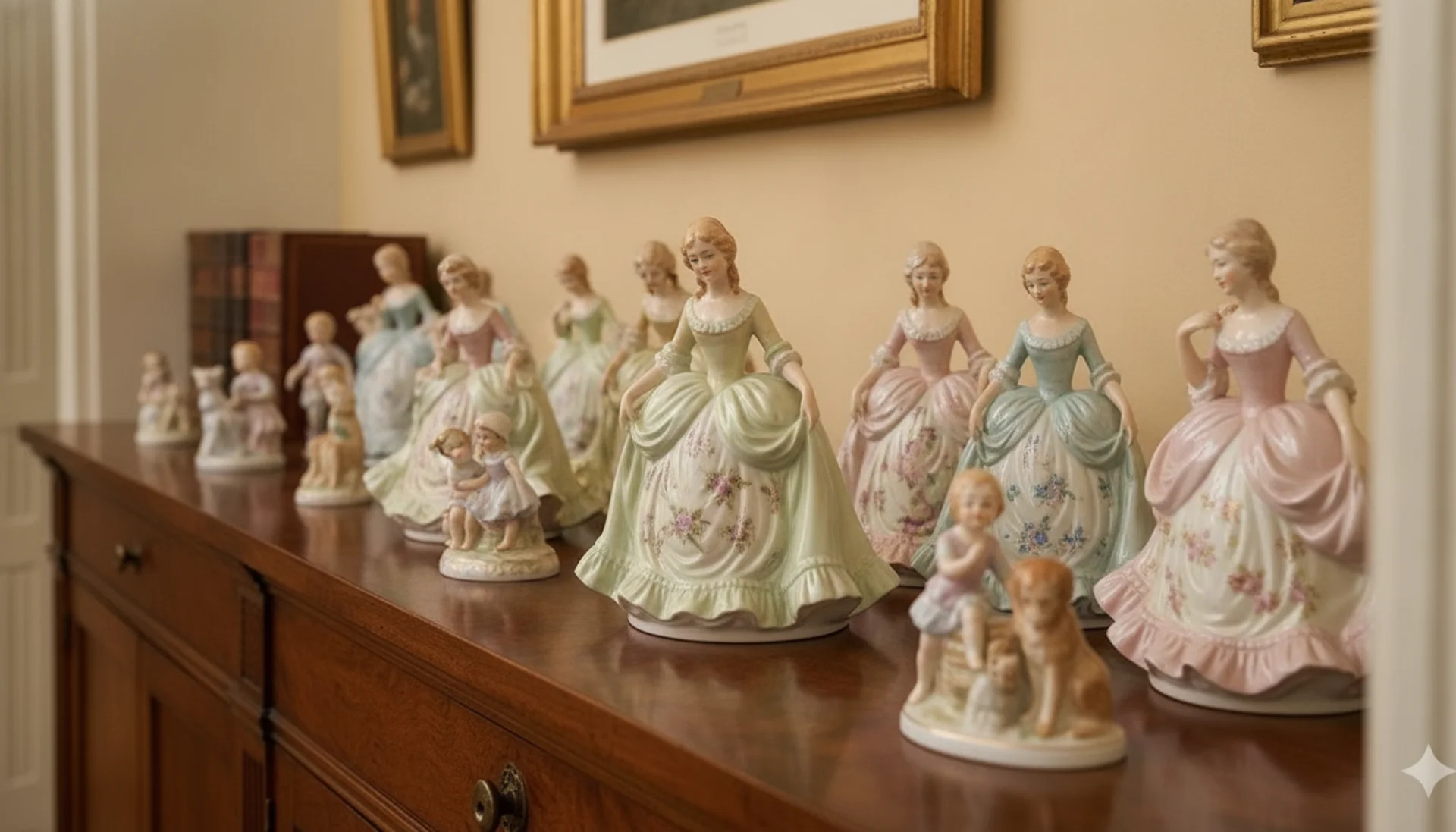
Whether you inherited a collection or have been collecting for years, knowing what your Royal Doulton figurines are worth starts with understanding what makes them valuable. This guide covers identification marks, HN numbering, valuation factors, the most sought-after pieces, and where to sell Royal Doulton figurines for the best price.
What Are Royal Doulton Figurines?
Royal Doulton figurines are hand-painted English porcelain figures, with the HN numbering system identifying many designs introduced from 1913 onward. Common later pieces may sell for under $150, while early HN numbers, rare colorways, prototypes, and excellent-condition examples can reach thousands. Value depends on identification, rarity, condition, subject, and provenance.
Royal Doulton figurines are hand-painted porcelain figures produced since 1913 by one of England’s most prestigious ceramic manufacturers, distinguished by the HN Series numbering system introduced by art director Charles Noke. The company traces its origins to 1815 when John Doulton founded a pottery in Lambeth, London, and earned the Royal Warrant from Queen Elizabeth II in 1971. Production of many classic figurine lines continued until 2005 when the brand was acquired by Waterford Wedgwood, making vintage and discontinued pieces among the most actively collected ceramics globally.
Royal Doulton figurines are hand-painted porcelain figures produced by Royal Doulton, one of England’s most prestigious ceramic manufacturers. The company traces its origins to 1815, when John Doulton founded a small pottery factory in Lambeth, London, producing household stoneware like inkwells and bottles.
The figurine line that collectors prize most today launched in 1913 when art director Charles Noke introduced the HN Series — a collection of character studies and decorative figures that would grow to include thousands of designs over the next century. The “HN” designation comes from Harry Nixon, the artist who painted many of the earliest pieces.
Royal Doulton earned the Royal Warrant from Queen Elizabeth II in 1971, cementing its position as one of England’s most respected potteries. Production of many classic figurine lines continued until 2005 when the brand was acquired by Waterford Wedgwood. Today, vintage and discontinued Royal Doulton figurines are among the most actively collected ceramics in the world.
Key Royal Doulton Product Lines
Royal Doulton produced far more than just figurines. Understanding the full range helps collectors identify and value their pieces:
- HN Figurines — The numbered porcelain figure series (HN1 through HN5000+), depicting ladies, gentlemen, characters, and scenes
- Character Jugs — Decorative face jugs depicting historical and fictional characters, produced from 1934 onward
- Toby Jugs — Full-bodied figure jugs, a traditional English form Royal Doulton elevated to fine art
- Flambé Ware — Pieces featuring the distinctive red-glazed technique inspired by Chinese ceramics
- Seriesware — Tableware and decorative items featuring printed or painted scene designs
- Kingsware — A distinctive brown-glazed line featuring relief-molded historical and literary scenes
- Lambeth Stoneware — Salt-glazed art pottery from the original Lambeth studio, including works by George Tinworth
- Bunnykins — Charming rabbit-themed figurines and tableware, beloved by both children and collectors
- Beatrix Potter — Licensed figurines of Peter Rabbit and friends, produced under the Beswick brand
How to Identify Royal Doulton Figurines
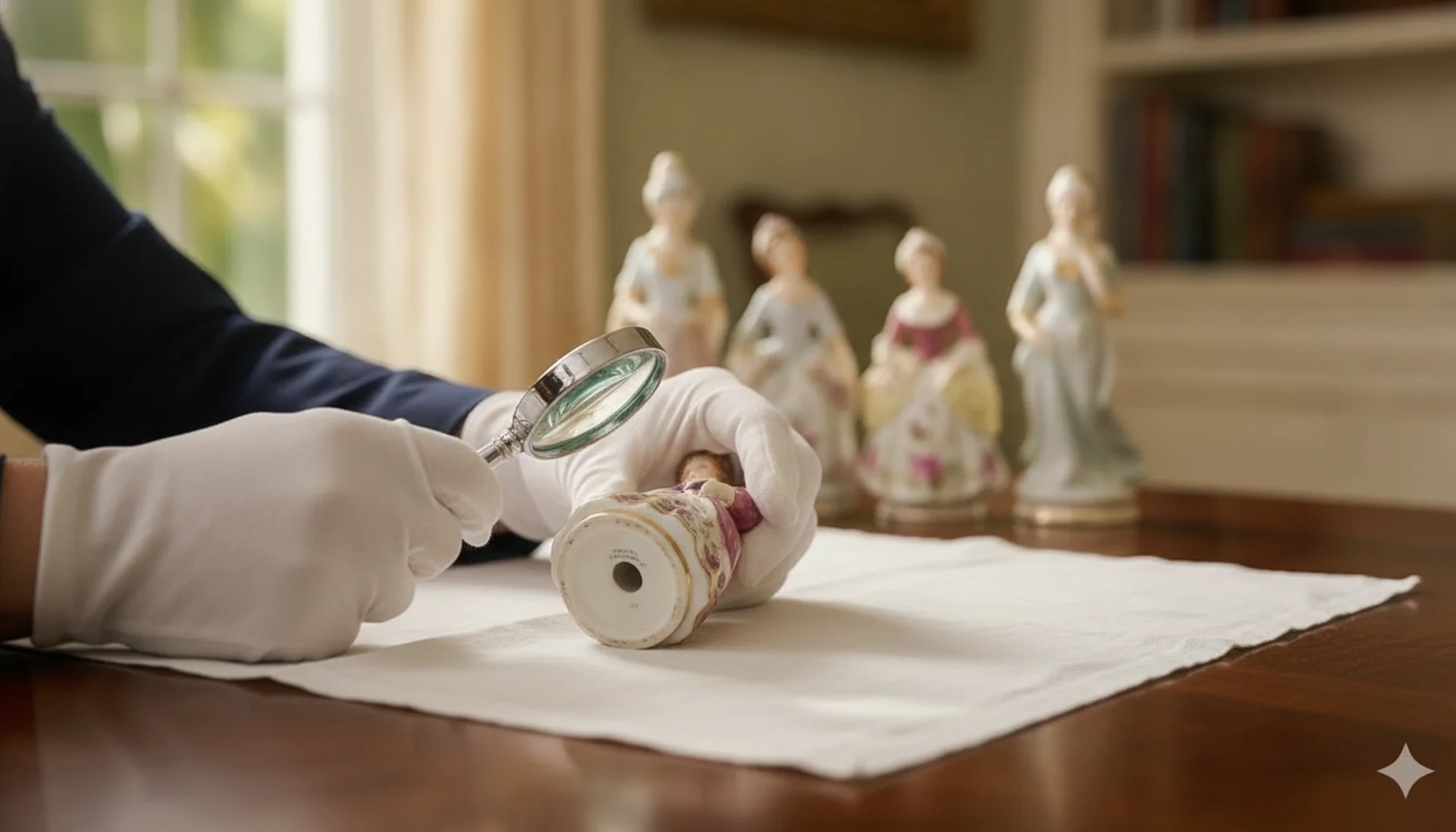
Identify Royal Doulton figurines by photographing the base, reading the backstamp, recording the HN number, and checking colorway or prototype markings against reliable catalogs. The backstamp helps date production, while the HN number identifies the design. Because rarity and condition vary within one model, confirm the exact version before estimating value.
Every genuine Royal Doulton figurine carries a printed backstamp on its base that evolved through different design eras useful for dating, plus a unique HN number that identifies the specific design and colorway in the catalog system instituted in 1913. According to Royal Doulton collector’s references, the presence of “BONE CHINA” under the backstamp indicates production after 1960, and some figurines were produced in multiple colorways with dramatically different rarity levels. The HN number combined with the colorway determines collector demand. For comparison, see the Royal Copenhagen figurine marks.
Correctly identifying Royal Doulton figurines is the first step to determining their value. Every genuine Royal Doulton piece carries specific markings on its base.
📖 Related: Where to sell collectibles
Backstamp Markings
The backstamp is the printed or stamped mark on the bottom of each piece. Royal Doulton used different backstamp designs across different eras, making them useful for dating:
- 1902–1922: Early lion and crown mark with “Royal Doulton England” text
- 1922–1927: Lion over crown backstamp, often with hand-painted “HN” number
- 1927–1932: Slightly redesigned lion and crown with added registration details
- 1932–1955: Backstamp includes “Made in England” below the lion and crown
- 1955–present: Simplified modern backstamp; post-2005 pieces may carry “Royal Doulton” without the traditional lion
The presence of “BONE CHINA” under the backstamp indicates pieces made after 1960 when Royal Doulton shifted much of its production to bone china formulas.
The HN Numbering System
Every Royal Doulton figurine in the main series carries an HN number — a sequential catalog number assigned when the design was first registered. This number is critical for identification and valuation:
- HN1 – HN100 (1913–1920s): The earliest and often most valuable figurines
- HN100 – HN1000 (1920s–1940s): Pre-war and wartime production, many now scarce
- HN1000 – HN2000 (1940s–1960s): Post-war expansion with broader subjects
- HN2000 – HN3000 (1960s–1980s): The golden age of figurine design, including many classic “lady” figurines
- HN3000 – HN4000 (1980s–2000s): Later production, including limited editions and character studies
- HN4000+ (2000s): Final production runs before major line discontinuations
Lower HN numbers generally indicate older pieces, but the number alone does not determine value. A figurine’s value depends on rarity, condition, and collector demand.
Color Variations and Prototypes
Royal Doulton frequently produced the same figurine design in multiple colorways. Some color variations are significantly rarer than others, which directly affects value. Markings to watch for include:
- “Potted by” followed by initials — Indicates the specific modeler
- “Survey Figure” — A prototype or trial piece, extremely rare
- “Factory Proof” — A test piece from production trials
- “Design Sample” or “Not Produced For Sale” — Pre-production pieces that can command thousands at auction
What Are Royal Doulton Figurines Worth?
Royal Doulton figurines can be worth under $20 for common later pieces, $20 to $500 for many collectible examples, and thousands or more for rare early HN numbers, prototypes, withdrawn designs, and unusual colorways. A trustworthy estimate matches the exact HN number and version with recent sales, then adjusts for condition, box, documentation, and demand.
Royal Doulton figurine values range widely from under $20 for common later-production pieces to tens of thousands for rare prototypes and early HN numbers. Auction market data shows that most post-1960 figurines sell for $20 to $100, pre-1960 pieces in good condition range from $100 to $500, and the rarest pre-war HN numbers and prototypes achieve $2,000 to $20,000-plus. The value hierarchy is driven by HN number rarity, age, condition including original box presence, and specific subject desirability. The Royal Copenhagen figurines value guide offers another porcelain value reference.
Royal Doulton figurine values range widely — from under $20 for common later-production pieces to tens of thousands for rare prototypes and early HN numbers. Here is a general pricing framework based on current auction market data. Ready to sell your collection? See our sell Lladro near me page.
Value Ranges by Category
| Category | Typical Value Range | Key Factors |
|---|---|---|
| Common HN figurines (1970s–2000s) | $20–$150 | Mass-produced, readily available |
| Mid-range collectible figurines | $150–$500 | Discontinued designs, good condition |
| Sought-after character figurines | $500–$2,000 | Limited production, popular subjects |
| Early HN numbers (pre-1940) | $1,000–$5,000 | Age, rarity, historical significance |
| Rare prototypes and variants | $5,000–$50,000+ | Unique colorways, factory proofs, one-of-a-kind pieces |
| Character Jugs (standard) | $30–$300 | Depends on size, character, and rarity |
| Character Jugs (rare/prototype) | $1,000–$20,000+ | Withdrawn designs, color trials, tiny variants |
Most Valuable Royal Doulton Figurines
Some Royal Doulton figurines consistently achieve strong prices at auction:
- HN1 “Darling” (1913) — One of the first figurines ever produced, early examples sell for $3,000–$10,000 depending on condition
- “Jester” HN45 (1915) — Early character piece with strong collector following, valued at $2,000–$6,000
- Bunnykins Prototypes — A rare Bunnykins design sample sold for $44,300 at auction, making it one of the most expensive Royal Doulton pieces ever
- “The Moor” HN2082 — A dramatic figure that commands $1,500–$4,000 in excellent condition
- Double-faced Character Jugs — Rare Mephistopheles and similar double-faced designs reach $3,000–$8,000
- Flambé Figurines — Animal figurines in the distinctive red flambé glaze, particularly large pieces, sell for $1,000–$5,000
5 Factors That Determine Royal Doulton Value
Royal Doulton value is determined chiefly by condition, rarity, HN number, age, subject, provenance, original packaging, and collector demand. Early or short-run pieces can command premiums, but age alone does not guarantee value. Chips, cracks, repairs, missing documentation, and common production can reduce the price substantially compared with a rare, complete example.
Five factors determine Royal Doulton figurine value in order of impact: condition (perfect condition is mandatory — chips or cracks reduce value by 70 percent or more), HN number rarity (limited production runs and withdrawn designs are scarcest), age (pre-1940 pieces command premiums due to fewer survivors), subject desirability (character studies and animals outperform generic decorative figures), and provenance including original box and documentation (adding 20 to 30 percent). These factors compound, so a rare HN figure in mint condition with its original box can be worth 40 times the same figure without packaging.
1. Condition
Condition is the single biggest factor affecting value. A figurine in perfect condition with no chips, cracks, repairs, or crazing will be worth significantly more than the same piece with damage.
What collectors check:
- Chips or nicks on extremities (fingers, noses, floral details)
- Hairline cracks, especially at the base
- Crazing (fine cracks in the glaze surface)
- Paint loss or fading
- Professional repairs (detectable under UV light)
- Original packaging and certificates of authenticity
A figurine with its original box and paperwork can be worth 20–30% more than the same piece without packaging.
2. Rarity and Production Numbers
Limited edition pieces, short production runs, and withdrawn designs are the most valuable. Royal Doulton produced some designs for decades, making them common. Others were made for only a few years, or in quantities of a few hundred, making them scarce.
Signs of rarity:
- Limited edition numbering on the base
- “Withdrawn” status in price guides
- Production dates spanning only 1–3 years
- Prototype markings (“Survey Figure,” “Factory Proof”)
- Color variations different from the standard production colorway
3. Age
Older figurines are not automatically more valuable, but early pieces (pre-1940 HN numbers) tend to command premiums because fewer have survived in good condition. The pre-war era of Royal Doulton is considered the artistic peak, when pieces were more individually hand-finished.
4. Subject and Character
Figurines depicting certain subjects are more desirable:
- Pretty Ladies — Elegant female figures in period dress remain the most popular collecting category
- Character Studies — Figures of tradespeople, historical characters, and literary figures
- Military Figures — Including the Soldiers of the Revolution series
- Animal Figures — Especially dogs, horses, and big cats in flambé glaze
- Paired Figures — Sets or complementary pairs often sell for more than individual pieces
5. Provenance and Documentation
Pieces with documented provenance — a known collection history, original purchase receipts, or certificates — carry additional value. Figurines from notable collections frequently achieve premium prices at auction.
How to Spot Fake Royal Doulton Figurines
Spot a potentially fake Royal Doulton figurine by checking the backstamp, HN number, painting, glaze, weight, and base for inconsistencies. Blurry typography, an incorrect HN designation, crude decoration, unusual weight, or a suspiciously low price are warning signs. Compare the piece with verified references and obtain professional authentication before buying or selling.
Fake Royal Doulton figurines can be identified through several markers: incorrect backstamp typography or colors, missing or poorly impressed HN numbers, crude painting with visible brush strokes outside the lines, lightweight construction compared to genuine bone china, and unnaturally glossy glazes. Collectors should compare suspected fakes against known authentic examples on Royal Doulton collector databases, which maintain photographic records of verified backstamps and HN number ranges. Any figurine with an HN number that falls outside the documented series range for its apparent era should be treated as suspicious.
The popularity of Royal Doulton has unfortunately led to reproductions and fakes entering the market. Here is what to look for:
Signs of Authenticity
- Clear, crisp backstamp — Genuine marks are sharply printed, not blurry or smudged
- Consistent glaze quality — Authentic pieces have smooth, even glaze without bubbles or runs in unexpected places
- Correct HN number format — The HN number should match the design in published catalogs
- Appropriate weight — Genuine bone china figurines have a specific heft; copies are often lighter or heavier
- Paint quality — Hand-painted details should show slight variations consistent with hand decoration, not mechanical uniformity
Red Flags
- Backstamp that looks too perfect or printed with modern inkjet quality
- HN number that does not correspond to the figurine design in Royal Doulton catalogs
- “Royal Doulton” spelled incorrectly or in an unfamiliar font
- Base that has been painted over (may hide a replaced or forged backstamp)
- Unusually low price for a supposedly rare piece
When in doubt, having a certified appraiser examine the piece is the safest way to confirm authenticity before buying or selling.
Collectors interested in European figurines may also want to explore our Hummel figurines for comparable porcelain collectibles.
For other European porcelain collectibles, see our Capodimonte covering this beloved Italian artform.
Where to Sell Royal Doulton Figurines
Sell Royal Doulton figurines through the channel that matches their value: common pieces may suit online marketplaces, mid-range collections can perform at regional auctions, and rare HN numbers or prototypes benefit from a specialist auction house. Authentication, accurate cataloging, professional images, careful packing, and access to qualified collectors can materially affect the final result.
The optimal selling venue for Royal Doulton figurines depends on value: common pieces under $100 sell quickly on eBay and Facebook collector groups, mid-range collections from $100 to $1,000 perform well at regional auctions, and rare HN numbers over $1,000 should go to specialty ceramics auctions or established auction houses with dedicated Royal Doulton specialists. Lion and Unicorn provides expert Royal Doulton authentication and valuation services, with national estate liquidation capabilities that ensure collections reach the right buyers through appropriate sales channels.
If you own Royal Doulton figurines and want to sell them, choosing the right venue makes a significant difference in what you receive.
Auction Houses
Selling through a reputable auction house is the most reliable way to achieve fair market value for Royal Doulton figurines, especially for rare or high-value pieces. Auction houses bring a built-in audience of serious collectors who are actively bidding.
Lion and Unicorn is one of the leading auction houses for Royal Doulton in the United States. With over 30 years of experience and deep specialization in European ceramics, Lion and Unicorn processes hundreds of Royal Doulton pieces every year — from individual figurines to complete collections. Ready to sell your collection? See our Lladro figurines value guide page.
Why collectors and estates choose auction:
- Competitive bidding can drive prices above estimated values
- Expert cataloging ensures pieces are correctly identified and described
- Global reach via online bidding platforms like LiveAuctioneers, Invaluable, and BidSquare
- Free appraisals available for Royal Doulton collections
Online Marketplaces
Platforms like eBay and Etsy work for common figurines in the $20–$200 range. However, they are not ideal for rare or high-value pieces because:
- Seller fees eat into margins
- Buyers may not understand the significance of rare pieces
- Risk of low offers or items sitting unsold for months
- No expert authentication or cataloging
Antique Dealers
Local antique dealers may buy Royal Doulton outright, but typically at 40–60% of retail value since they need to mark up for resale. This can be a quick option for common pieces but leaves money on the table for anything genuinely rare.
Estate Sales
If Royal Doulton figurines are part of a larger estate, a full-service estate sale through a professional company handles the entire process from inventory to sale. This is often the best approach when you have dozens or hundreds of pieces alongside other household items.
Caring for Your Royal Doulton Collection
Care for a Royal Doulton collection by handling each piece with clean, dry hands, displaying it on stable surfaces away from impacts and temperature swings, and dusting gently without soaking painted or gilded areas. Keep boxes and paperwork, avoid unverified repairs, and document existing condition so future appraisals and sales reflect the collection accurately.
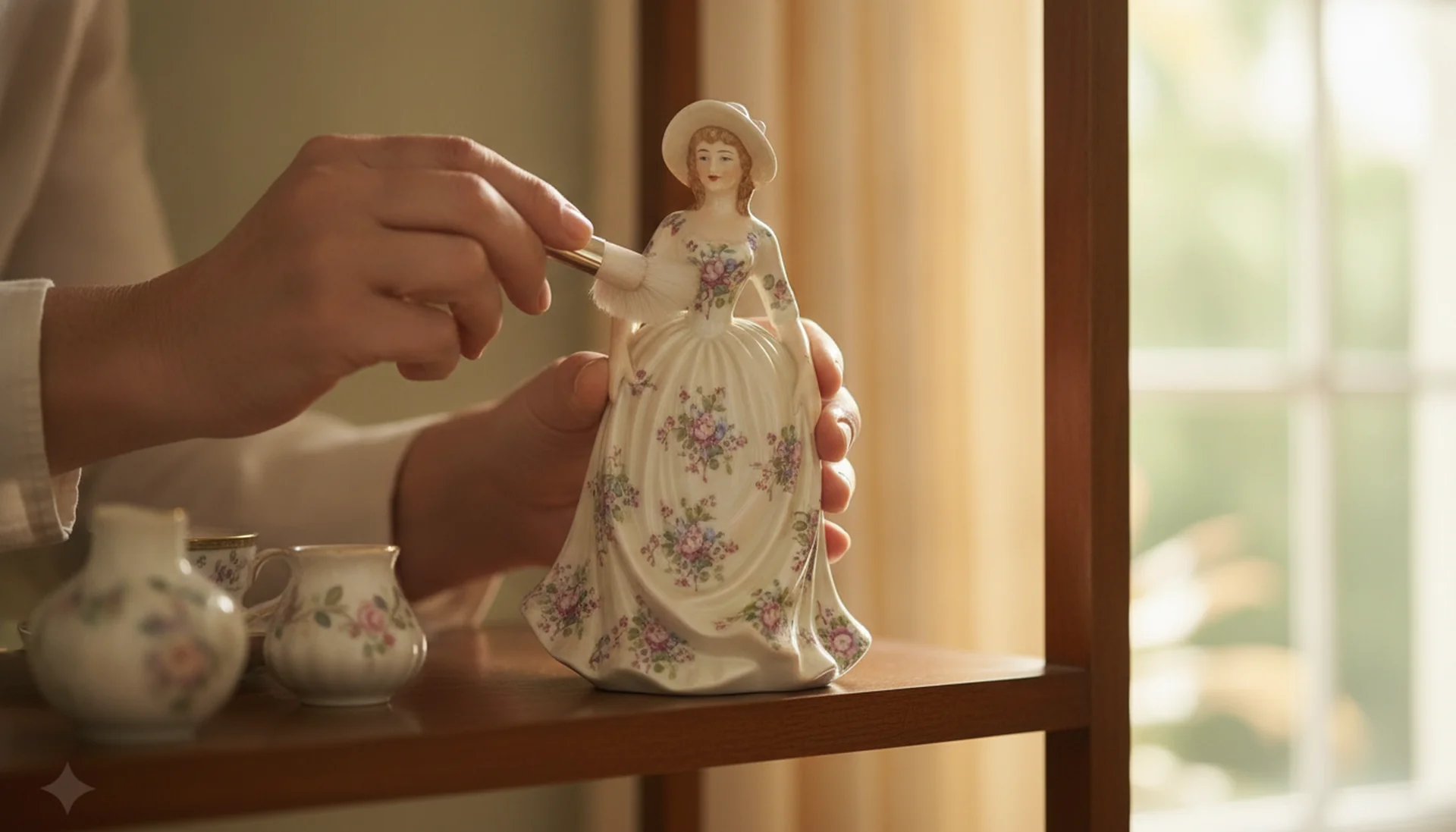
Proper care for Royal Doulton figurines involves displaying them away from direct sunlight (which causes glaze fading and crazing), dusting with a soft makeup brush rather than wiping (which can snag on delicate extremities), and never immersing in water (which can seep into glaze cracks). Royal Doulton’s character jugs and figurines with protruding elements like hands, hats, and flowers are especially vulnerable to breakage and should be displayed in stable locations away from high-traffic areas. Professional conservation is recommended for any valuable piece that sustains damage.
Proper care preserves both the beauty and value of Royal Doulton figurines:
- Display in enclosed glass cabinets to minimize dust and accidental knocks
- Avoid direct sunlight, which can fade painted details over time
- Clean gently with a soft, dry brush — never soak figurines in water or use chemical cleaners
- Handle by the base, not by delicate extremities like arms, flowers, or hats
- Keep original packaging — boxes, certificates, and inserts significantly increase resale value
- Document your collection with photographs and a record of HN numbers, purchase dates, and prices paid
Frequently Asked Questions
Are Royal Doulton figurines still being made?
Royal Doulton was acquired by Waterford Wedgwood in 2005, and most of the classic figurine lines were discontinued. Some limited pieces are still produced under the Royal Doulton brand, now owned by Fiskars Group, but the golden age of figurine production ended in the early 2000s. This means most Royal Doulton figurines on the market today are vintage or retired pieces.
How do I find the value of a specific Royal Doulton figurine?
Start by locating the HN number on the base of the figurine. Cross-reference this number with a Royal Doulton price guide or catalog to identify the design name, production years, and estimated value range. For an accurate current market value, consult a certified appraiser who specializes in European ceramics or check recent auction results for the same HN number.
What is the most expensive Royal Doulton figurine ever sold?
One of the highest prices achieved for a Royal Doulton piece is $44,300 for a rare Bunnykins prototype at auction. Among HN figurines, early pieces like HN1 “Darling” and rare color trials have sold for $10,000 or more. Character jug prototypes and withdrawn designs also regularly achieve five-figure prices.
Are Royal Doulton character jugs valuable?
Yes, Royal Doulton character jugs are a major collecting category. Common character jugs sell for $30–$300, but rare designs, withdrawn characters, and prototype pieces can reach $1,000–$20,000 or more. The most valuable tend to be early production large-size jugs, double-faced designs, and characters that were only produced briefly before being withdrawn.
Should I sell Royal Doulton figurines individually or as a collection?
It depends on the collection. High-value individual pieces (rare HN numbers, prototypes, sought-after characters) typically do better sold individually to targeted collectors. Common pieces may sell faster as lots or grouped sets. A professional appraiser can help you determine the best strategy for your specific collection.
Where is the best place to sell Royal Doulton figurines?
For the best prices on valuable Royal Doulton figurines, a specialized auction house is the recommended option. Lion and Unicorn has over 30 years of experience selling Royal Doulton, with certified appraisers, global bidding reach, and a buyer network that includes serious Royal Doulton collectors worldwide. They offer free appraisals and nationwide pickup for consignment pieces. Call (954) 866-8044 to discuss your collection.
Lion & Unicorn can help you sell porcelain figurines and other decorative arts through auction.
Have antiques, art, or collectibles you’re ready to sell? Contact Lion and Unicorn to speak with our team.
Free Consultation
Ready to Sell Your Estate or Collection?
Lion & Unicorn's expert team offers free appraisals and nationwide pickup service.
Over 30 years of experience — Florida's most trusted auction house.